
GEO vs AEO vs AIO vs LLMO Explained
- Arabest
- September 8, 2026
- SEO & AEO
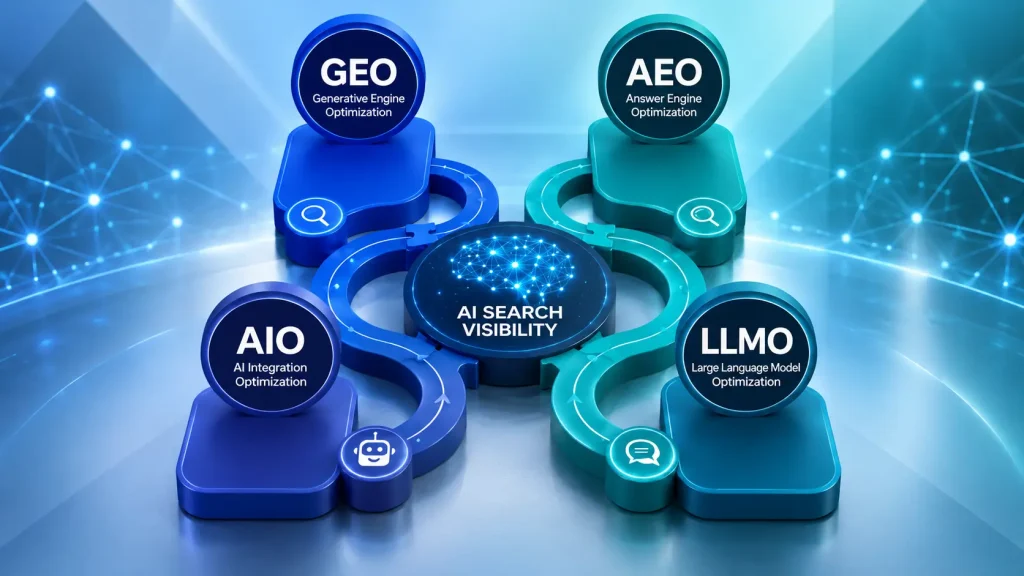
GEO, AEO, AIO and LLMO are four ways to improve how your business is discovered, understood and used in AI driven search and customer journeys.
This article is for South African business owners, agencies, consultants and service based businesses that want to understand the difference without getting lost in technical language.
The GEO vs AEO vs AIO vs LLMO comparison can feel confusing because the four approaches overlap. GEO focuses on generative search visibility. AEO focuses on clear answers. AIO focuses on how people interact with AI on your own channels. LLMO focuses on helping large language models understand accurate facts about your business.
At Arabest, we help businesses connect these ideas into a practical digital visibility strategy that supports SEO, Answer Engine Optimisation, AI search visibility, website content, local visibility, WhatsApp marketing, lead generation and better customer journeys.
Quick Answer
GEO helps your business appear in generative search results. AEO helps your content answer customer questions clearly. AIO improves AI conversations on your website, WhatsApp or chatbot. LLMO helps large language models understand accurate facts about your business. Together, they support visibility, trust and conversion.
Why Are GEO, AEO, AIO and LLMO Important?
Why should businesses understand these AI optimisation terms?
Businesses should understand GEO, AEO, AIO and LLMO because customers are using more than traditional search engines to find information. People now ask questions through Google AI Overviews, ChatGPT, Gemini, Copilot, Perplexity, Claude, voice assistants, website chatbots and WhatsApp flows.
A business that only thinks about normal keyword rankings may miss how people discover and evaluate brands through AI supported answers.
These four areas help answer different questions:
- Can AI systems find you?
- Can they understand you?
- Can they trust your answers?
- Can your own AI tools help customers take action?
Start With the Simple Difference
What is the easiest way to understand the difference?
The easiest way to understand GEO vs AEO vs AIO vs LLMO is to connect each term to a simple business goal.
LLMO helps large language models understand who your business is. AEO helps your content become clear enough to answer customer questions. GEO helps your website or brand become more likely to be cited or referenced in generative search results. AIO helps turn AI conversations into enquiries, bookings, quotes or sales.
A simple order for many businesses is:
1. First, make your business facts clear with LLMO.
2. Next, answer customer questions clearly with AEO.
3. Then, improve generative search visibility with GEO.
4. Finally, improve customer conversations and conversions with AIO.
This order makes sense because AI systems cannot confidently mention, quote or recommend a business they do not understand.
What Is GEO?
What does GEO mean in digital marketing?
GEO means Generative Engine Optimisation. It focuses on improving how your content appears, gets referenced or gets cited in generative search experiences. Generative search can include AI powered search results, AI summaries, Perplexity answers, Bing Copilot responses and Google AI Overviews.
In simple terms, GEO asks:
Is your content useful enough, credible enough and structured enough for an AI search system to use as a source?
For example, a Cape Town plumbing business may publish a clear guide about what to do after a burst pipe. The guide could include local callout factors, photos, safety steps, service areas and common customer questions.
That content has a better chance of being understood than a thin page that only says:
We offer professional plumbing services.
For extra context on Google’s AI search features, you can read Google’s official guidance on generative AI features in Search. GEO is about becoming a better source for AI generated search results.
How Can a Business Improve GEO?
What makes content more useful for generative search?
Content becomes more useful for generative search when it is clear, specific, current, local and supported by proof. Generative search systems often look for content that can help answer a user’s question directly. A vague page is harder to use. A clear guide with local context is easier to understand.
A South African business can support GEO by publishing helpful content that includes real service details, accurate locations, practical examples, updated dates, labelled images, clear headings and useful references where appropriate.
For a local service business, this could include turnaround times, pricing factors, service areas, product comparisons, customer questions and proof of work. Do not add details that are not true. GEO works best when the content is useful and accurate.
What Is AEO?
What does AEO mean in simple terms?
AEO means Answer Engine Optimisation. It helps your content answer customer questions clearly so search engines, AI tools and voice assistants can understand and summarise it. AEO is different from writing long content that hides the answer. It places the main answer close to the question.
For example, a customer may ask:
How much does garden maintenance cost in Pretoria?
An AEO friendly page would give a direct answer first, then explain the pricing factors below. AEO is useful because people often search in full questions. They want a clear answer before they decide whether to call, book or request a quote.
For a deeper explanation, read Arabest’s guide on Answer Engine Optimisation.
How Can a Business Improve AEO?
What makes a page easier for answer engines to understand?
A page becomes easier for answer engines to understand when it uses clear questions, direct answers, short paragraphs, helpful structure and accurate supporting detail. The first answer should not be buried deep in the article. It should appear directly below the relevant question or heading.
A strong AEO section often includes a natural customer question, a direct answer in the first sentence, supporting details, local context where relevant, trust signals and a clear next step.
For example, a Durban tax consultant could create a page that answers a common tax question with a short answer, then explains what it means in South Africa, what documents may be needed and when the person should speak to a professional.
Schema markup can also help search engines understand the page type and content. The Schema.org structured data vocabulary is a useful reference for understanding how structured data can describe pages, organisations, services, articles and FAQs.
AEO is not about stuffing keywords into every paragraph. It is about making answers easier to understand and use.
What Is LLMO?
What does LLMO mean for a business?
LLMO means Large Language Model Optimisation. It helps AI models understand accurate facts about your business. A large language model may know information from many sources, but it can also become confused if your online details are weak, inconsistent or unclear.
LLMO focuses on making your business facts easier to find, verify and connect. These facts may include your business name, services, locations, contact details, team information, service areas, pricing guidance, product information, policies, reviews and public brand information.
A useful way to think about LLMO is this:
You are creating a clean source of truth for AI systems, search engines and customers.
The clearer your public business facts are, the easier it is for AI tools to understand who you are and what you do.
How Can a Business Improve LLMO?
What facts should large language models understand about your business?
Large language models should be able to understand your business name, what you offer, who you help, where you operate and how people can contact you. These details should match across your website, Google Business Profile, Facebook, Instagram, LinkedIn and trusted business listings.
If one platform lists one phone number and another platform lists a different one, it creates uncertainty. If your website describes your services differently from your Google Business Profile, it can weaken the connection between your business and the services you want to be known for.
LLMO can be supported by clear About content, service pages, FAQ pages, business profiles, schema markup, public company information and consistent local listings. The goal is not to trick AI models. The goal is to make accurate business information easier to understand.
What Is AIO?
What does AIO mean in customer journeys?
AIO means AI Interaction Optimisation. It focuses on how people interact with AI on your own channels, such as your website chat, WhatsApp assistant, booking bot or support flow. AIO is not mainly about being found in search. It is about what happens after a customer starts a conversation.
For example, a customer may ask a WhatsApp assistant:
Do you offer weekend inverter installations in Pretoria East?
A useful AI interaction should answer clearly, ask the right follow up questions and guide the customer to a realistic next step. That next step may be a quote request, consultation booking, site visit request, product recommendation or handover to a human team member. AIO is where visibility turns into action.
How Can a Business Improve AIO?
What makes an AI assistant useful instead of frustrating?
An AI assistant becomes useful when it has clear guardrails, accurate business information and a practical handover process.
A poor AI assistant gives vague answers, makes promises the business cannot keep or traps customers in a loop. A stronger AI assistant knows what it can answer, what it cannot answer and when to pass the enquiry to a human.
For a South African service business, an AI assistant could ask for the customer’s suburb, service need, budget range, urgency and preferred contact method. It should not guess prices, promise availability or give legal, medical, financial or technical advice unless the business has approved that information. AIO should make the customer journey faster, clearer and safer.
How Do GEO vs AEO vs AIO vs LLMO Compare?
Why should businesses not treat these as separate strategies?
Businesses should not treat GEO, AEO, AIO and LLMO as separate strategies because they support different parts of the same customer journey.
LLMO helps AI systems understand the business facts. AEO helps the website answer questions clearly. GEO helps useful content become more visible in generative search. AIO helps turn AI driven enquiries into practical next steps.
For example, a Pretoria solar company may need consistent business facts across its website and profiles. That supports LLMO.
It may then create answer based content around solar pricing, inverter options and installation timelines. That supports AEO.
If the content is strong and trusted, it may be more likely to appear as a source in generative search results. That supports GEO.
When a customer clicks through or sends a WhatsApp message, a guided assistant can ask helpful questions and route the enquiry. That supports AIO.
Together, the four areas help a business become easier to find, understand, trust and contact.
A Practical South African Example
How could one business use all four together?
A home improvement business in Johannesburg could use LLMO, AEO, GEO and AIO together by improving business facts, customer answers, generative search visibility and enquiry handling. Let us say the business offers kitchen renovations, bathroom upgrades and cupboard installations in Johannesburg North.
First, the business updates its website, Google Business Profile and social profiles so the name, services, areas and contact details match. That supports LLMO.
Next, the business adds clear answer sections to its website. It answers questions such as how long a kitchen renovation takes, what affects pricing and what customers should prepare before requesting a quote. That supports AEO.
Then, the business publishes a useful local guide on planning a kitchen renovation in Johannesburg, with process steps, realistic timelines, photos and common mistakes to avoid. That supports GEO.
Finally, the business adds a WhatsApp enquiry flow that asks for the customer’s suburb, room type, rough budget, preferred timing and photos of the current space. That supports AIO.
This approach connects visibility with better enquiries.
Which One Should a Small Business Start With?
What should a business prioritise on a limited budget?
A business with a limited budget should usually start by making its business facts clear and its customer answers useful. That means LLMO and AEO often come before more advanced GEO or AIO work.
Start by checking whether your website clearly explains who you are, what you offer, where you work and how people can contact you. Then answer the questions customers ask most often before they enquire.
Once that foundation is clear, you can improve generative search visibility through stronger guides, local proof and more useful resources. AIO can come later when you are ready to improve chat, WhatsApp, bookings or lead qualification. The right order depends on the business, but weak foundations should be fixed first.
A 30 Day Action Plan
How can a business start improving AI visibility this month?
A business can start improving AI visibility by fixing basic business facts, adding clear answers, improving local content and tracking customer actions.
In week one, check your business name, phone number, website link, service descriptions, locations and opening hours across important platforms.
In week two, rewrite key pages so they include direct answers to real customer questions.
In week three, publish one useful local resource, such as a guide, checklist, pricing factors article or process explanation.
In week four, improve one enquiry path, such as a WhatsApp flow, contact form or booking process.
This 30 day approach is practical because it improves both visibility and customer action.
What Should Businesses Measure?
How do you know if GEO, AEO, AIO or LLMO is working?
You know these strategies are working when your business becomes easier to find, easier to understand and easier to contact. Useful signs include more relevant search impressions, better question based rankings, stronger Google Business Profile actions, more qualified WhatsApp enquiries, clearer AI tool responses, better lead quality and fewer repeated basic questions.
For GEO, you can check whether your brand or pages are being referenced in AI search experiences where possible.
For AEO, track whether answer based pages attract traffic, clicks and enquiries.
For LLMO, test whether AI tools describe your business accurately.
For AIO, measure chat conversions, booked calls, quote requests, handovers to humans and response quality.
The goal is not only visibility. The goal is visibility that supports real business growth.
What Should Businesses Be Careful About?
What claims should businesses avoid with AI optimisation?
Businesses should avoid claiming guaranteed AI rankings, guaranteed mentions, guaranteed leads or guaranteed revenue from AI optimisation.
No business can fully control what Google AI Overviews, ChatGPT, Gemini, Copilot, Perplexity, Claude or any other answer engine will show. It is more accurate to say that strong content, clear business facts, structured information, local proof and useful answers can improve how well AI systems understand your business.
Businesses should also avoid adding fake reviews, false service areas, unsupported pricing, inaccurate credentials or misleading availability. AI visibility should be built on accurate information. Trust is more valuable than a shortcut.
How Arabest Helps
How can Arabest help with GEO, AEO, AIO and LLMO?
Arabest helps South African businesses improve AI search readiness, answer based content, business clarity and digital growth systems.
We help businesses identify unclear information, improve website content, create useful FAQs, support schema planning, strengthen local visibility, optimise social profiles, improve WhatsApp enquiry paths and connect visibility to lead generation.
Arabest services include SEO, Answer Engine Optimisation, GEO and local visibility, AI digital marketing, website content optimisation, Google Business Profile support, social media marketing, WhatsApp marketing, lead generation, reporting and business growth systems.
The goal is to help your business become easier for people, search engines and AI tools to find, understand, trust and contact.
Need help turning AI visibility into better enquiries?
Arabest helps South African businesses improve GEO, AEO, AIO, LLMO, SEO, website content, local visibility and lead generation through practical digital growth systems.
What Is the Best Next Step?
Where should a business start with AI search visibility?
The best next step is to check whether your business information is clear, consistent and useful across your website and online profiles.
Start with your foundation. Confirm that your name, services, location, contact details and core offering are easy to understand. Then add direct answers to real customer questions. After that, build stronger local resources, improve your enquiry paths and measure what turns visibility into leads.
GEO vs AEO vs AIO vs LLMO should not be treated as a competition between buzzwords. They should help your business become clearer, more useful and more measurable. Arabest can help you turn these ideas into a practical plan for AI search visibility and better enquiries.
Frequently Asked Questions
Most small businesses should start with LLMO and AEO because they improve the foundation. LLMO helps AI tools understand accurate business facts, while AEO helps your website answer customer questions clearly. Once that is stronger, GEO and AIO can support wider visibility and better enquiry handling.
GEO can support visibility in generative search results by making your content more useful, local, structured and credible. It cannot guarantee mentions or citations. A strong GEO approach uses helpful content, clear headings, updated information, trusted references and proof that helps AI search systems understand your business.
AEO focuses on making your content easier for search engines, AI tools and voice assistants to understand and summarise. AIO focuses on how customers interact with AI on your own channels, such as WhatsApp, website chat or booking flows. AEO supports answers, while AIO supports customer action.
LLMO matters because AI tools need accurate information before they can describe or recommend a business confidently. Local businesses should keep their name, services, locations, contact details and profiles consistent. This reduces confusion and helps AI systems connect the business to the right services and areas.